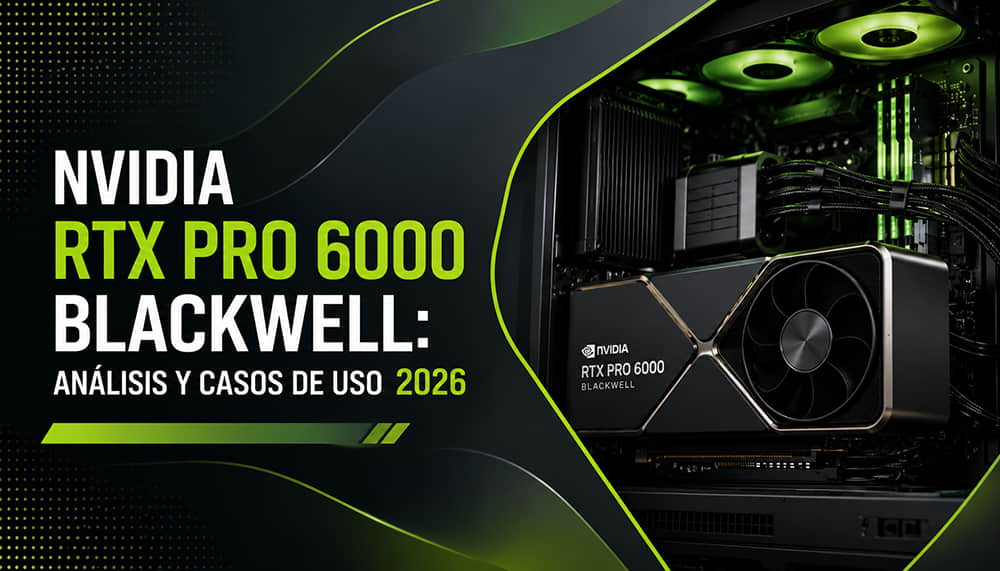
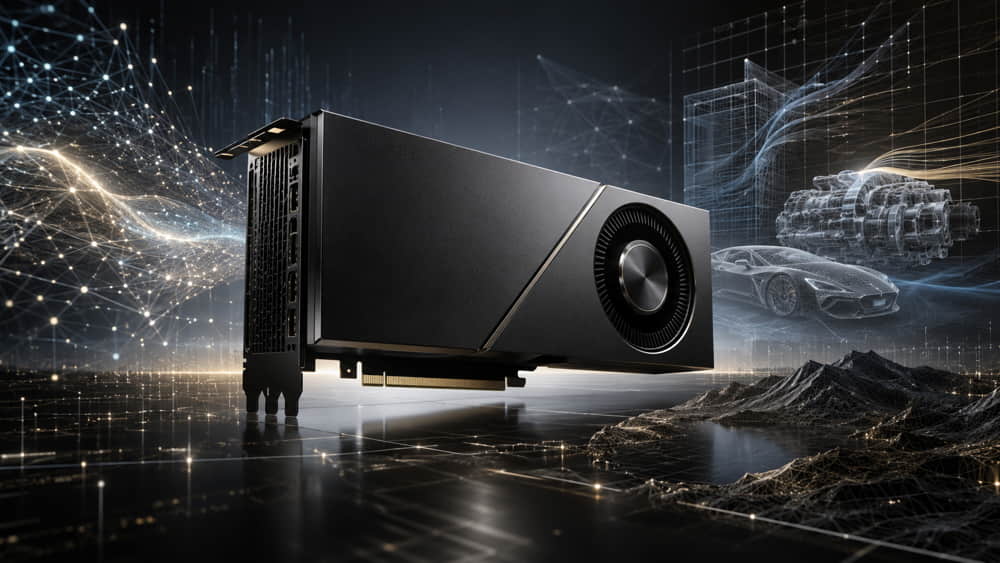
The arrival of the Blackwell architecture has marked one of NVIDIA’s biggest advances in recent years. Within the professional range, the undisputed protagonist is the NVIDIA RTX PRO 6000 Blackwell, a GPU designed for high-performance workstations that combines advanced capabilities for artificial intelligence, 3D rendering, simulation, engineering and professional visualization.
With 96 GB of GDDR7 memory, more than 24,000 CUDA cores and power aimed at the most demanding environments, this graphics card is positioned as the natural successor to the RTX 6000 Ada and as one of the most attractive options for companies that need to accelerate complex workflows without moving to data center platforms such as NVIDIA H100 or H200.
In this analysis, we review its specifications, performance, real advantages and the scenarios where it is truly worth investing in it.
What is the RTX PRO 6000 Blackwell and what changes compared to the RTX 6000 Ada?
The RTX PRO 6000 Blackwell is NVIDIA’s most powerful professional GPU for individual workstations in 2026. It is aimed at artificial intelligence, industrial design, engineering, BIM, architecture, 3D rendering, scientific simulation and advanced visualization.
Its main innovation compared to the Ada Lovelace generation is the incorporation of the Blackwell architecture, which introduces significant improvements in Tensor performance, AI inference, Ray Tracing, memory management, energy efficiency and performance per watt.
While the RTX 6000 Ada was already a benchmark in professional environments, Blackwell further widens the gap compared to previous generations.
Full technical specifications
The specifications make this GPU a true benchmark for workstations.
Specification
RTX PRO 6000 Blackwell
Architecture
Blackwell
Memory
96 GB GDDR7 ECC
CUDA Cores
24,064
Tensor Cores
752, 5th generation
RT Cores
188, 4th generation
Interface
PCIe Gen5
Power consumption
600 W
ECC
Yes
Multi-GPU
Yes
NVLink
Depending on configuration
Segment
Professional workstation
The combination of 96 GB of memory and the new generation of Tensor Cores makes it an extremely versatile platform.
The importance of 96 GB GDDR7
Memory is one of the most distinctive aspects of this GPU. Many modern professional projects are limited by memory capacity before they are limited by computing power.
The 96 GB GDDR7 allows users to work with huge rendering scenes, run large AI models, process complex digital twins, manage massive BIM projects and perform advanced simulations.
For many studios and technical departments, this represents a huge advantage over GPUs with 24 GB or 48 GB.
3D rendering performance
One of the environments where the RTX PRO 6000 Blackwell stands out the most is professional rendering.
Octane Render
Octane makes intensive use of CUDA, Tensor Cores and the large VRAM capacity. The RTX PRO 6000 Blackwell allows users to work with much more complex scenes, high-resolution textures and smooth interactive rendering, especially in architectural visualization and professional CGI projects.
Redshift
Redshift is one of the most widely used render engines in professional production. The new Blackwell generation offers shorter render times, better performance in heavy scenes and greater capacity for complex geometries. Animation and motion graphics studios are among the main beneficiaries.
V-Ray GPU
In V-Ray GPU, the improvement is especially noticeable when working with a large number of assets, multiple cameras, heavy textures or complex lighting. The 96 GB helps avoid many common issues related to lack of memory.
Artificial intelligence performance
AI is probably the area where this GPU is generating the most interest.
Local inference of LLMs
More and more companies are looking to run models locally. The RTX PRO 6000 Blackwell makes it possible to work with Llama, Mistral, DeepSeek, Qwen and multimodal models without necessarily depending on cloud infrastructure. This is especially interesting for companies with privacy requirements, public organizations and R&D departments.
Model fine-tuning
One of the most interesting use cases is fine-tuning. With techniques such as LoRA, QLoRA and quantization, it is possible to adapt advanced models using a single workstation. The 96 GB of VRAM makes it possible to work with models that would be out of reach for many traditional professional GPUs.
Generative AI for design
The combination of AI and professional design is growing rapidly. The RTX PRO 6000 Blackwell stands out in Stable Diffusion, image generation, AI-assisted industrial design, product variation generation and concept art. This makes it a very interesting tool for creative studios.
CAD, BIM and engineering: when is it worth it?
Not every user needs a GPU of this level. However, there are scenarios where it is fully justified.
Autodesk Revit
Especially useful in hospitals, airports, infrastructure projects and massive collaborative projects, where model complexity can grow enormously.
AutoCAD
For standard projects, it will probably be excessive. But in environments with huge models, advanced visualization and simulation, it can provide significant improvements.
Siemens NX and CATIA
In advanced engineering, the benefits are much more evident, particularly in automotive, aerospace, industrial manufacturing and heavy engineering.
RTX PRO 6000 Blackwell vs RTX 6000 Ada
The most logical comparison is against its predecessor.
Feature
RTX 6000 Ada
RTX PRO 6000 Blackwell
Architecture
Ada
Blackwell
Memory
48 GB
96 GB
Memory type
GDDR6
GDDR7
Tensor Cores
4th gen
5th gen
RT Cores
3rd gen
4th gen
AI
Excellent
Much superior
Rendering
Excellent
Superior
The most important difference lies in the double memory capacity, the more advanced Tensor Cores and the improved AI performance.
RTX PRO 6000 Blackwell vs L40S vs H100
This is a common comparison among enterprise customers.
GPU
Ideal environment
RTX PRO 6000 Blackwell
Workstations
NVIDIA L40S
Server inference and visualization
NVIDIA H100
Massive AI training
When to choose RTX PRO 6000 Blackwell
We recommend this GPU when a workstation is required, when there is a mix of AI and graphics workloads, when working in CAD and rendering, or when flexibility is needed.
When to choose L40S
The L40S is usually a better option for inference servers, VDI, render farms and remote visualization.
When to choose H100
The H100 remains the benchmark for training large LLMs, HPC, HGX infrastructure and enterprise clusters.
Power consumption, cooling and system requirements
A GPU of this level requires a suitable platform.
Power consumption
The TDP is around 600 W. This means high-quality power supplies, optimized cooling and professional chassis are required.
Recommended power supply
Depending on the configuration: 1,200 W for basic systems and 1,600 W or more for advanced configurations, always with Platinum or Titanium certification.
Chassis and airflow
It is essential to have optimized front airflow, space for large GPUs and professional thermal management. An unsuitable chassis can seriously limit performance.
Compatible workstations
Some especially suitable platforms include AMD Threadripper PRO, Intel Xeon W and professional multi-GPU configurations. The choice will depend on the main use case: AI, rendering, CAD or simulation.
Availability and estimated price in Spain
The RTX PRO 6000 Blackwell is currently among the most in-demand professional GPUs on the market. Its price may vary depending on the integrator, configuration, availability and type of workstation. As it is an enterprise product, it is usually sold mainly through specialized distributors and professional integrators.
Frequently asked questions
How much memory does the RTX PRO 6000 Blackwell have?
It has 96 GB of GDDR7 memory with ECC.
Is it suitable for AI?
Yes. It is one of the best professional GPUs for inference and fine-tuning in a workstation.
Can it replace an H100?
It depends on the project. For many enterprise AI tasks, yes, but not for massive training of large models.
Is it worth upgrading from an RTX 6000 Ada?
If you work with AI, heavy rendering or need more memory, the improvement is considerable.
Is it suitable for CAD and BIM?
Yes, especially in large and complex projects.
Conclusion
The NVIDIA RTX PRO 6000 Blackwell represents one of the biggest generational leaps we have seen in the professional GPU market. Its 96 GB of GDDR7 memory, fifth-generation Tensor Cores and Blackwell architecture make it an extraordinarily versatile solution for companies that need to combine artificial intelligence, 3D rendering, CAD, BIM, simulation and advanced visualization.
For many professionals, it offers the perfect balance between traditional workstation GPUs and expensive data center platforms.